It is not necessary to understand a bit of science history to enjoy the first book in the new science fiction series The Fermi Assumption, but it might put some matters into context. The Prelude to the series “New Neighbours” is available now and ‘the ‘When The Silence Ends” will be published on 4 March, 2026. It is available to preorder from Amazon.
March 4th has played a significant role in the development of astronomy and our scientific understanding of the universe.
1675 — John Flamsteed and the Birth of Systematic Astronomy
On 4 March 1675, John Flamsteed was appointed “our Astronomical Observer” by King Charles II — effectively becoming the first Astronomer Royal. This formalised astronomy in England as a systematic, state-backed observational science. Under royal instruction, Flamsteed was tasked with:
“the rectifying of the tables of the motions of the heavens, and the places of the fixed stars, so as to find out the so much desired longitude of places for the perfecting of the art of navigation.”
Flamsteed’s work laid the foundations for the Royal Observatory, Greenwich, whose foundation stone he later laid on 10 August 1675.
⸻
1774 — William Herschel and the Deep Sky
Exactly 99 years later — 4 March 1774 — Sir William Herschel, one of the most important observational astronomers of the 18th century, recorded his first detailed observation of the Orion Nebula (M42).
Using telescopes of unprecedented power for his time, Herschel resolved nebulae into stars, observed regions where stars appear to be forming, and described nebulous objects as:
“chaotic material of future suns.”
Herschel’s deep-sky surveying, alongside the astronomical work of his sister Caroline Herschel and son John Herschel, fundamentally shaped our understanding of star clusters, nebulae, and the structure of the Milky Way. Their legacy influenced later observatories and missions, including the Herschel Space Observatory.
Herschel’s work marks an important psychological shift in astronomy: humanity began to realise that the universe is not just vast, but also structured and dynamic — with regions where stars are born.
Key realisations from this era:
• The universe has large-scale structure
• Stars form in identifiable regions
• Complexity and evolution are inherent to deep space
⸻
1859 — Aleksandr Popov and the Advent of Radio
On 4 March 1859, Russian physicist and electrical engineer Aleksandr Popov was born. In Russia and parts of Eastern Europe, Popov is celebrated as a pioneer of radio communication, having demonstrated an early radio receiver in 1895, shortly before similar work by Guglielmo Marconi.
Radio technology would later become crucial to modern astronomy and the Search for Extraterrestrial Intelligence (SETI).
⸻
1923 — Sir Patrick Moore
Also born on 4 March (in 1923) was Sir Patrick Moore, the beloved British astronomer, writer, and broadcaster best known for hosting The Sky at Night for over 50 years. Moore popularised astronomy for generations and took an active interest in questions about life beyond Earth.
⸻
1950 — Fermi Asks “Where Is Everybody?”
In March 1950, during a lunch conversation at Los Alamos National Laboratory, physicist Enrico Fermi posed a deceptively simple but profound question:
“Where is everybody?”
The question emerged in the context of post-war cosmology, burgeoning space science, and early discussions about extraterrestrial life — and later became known as the Fermi Paradox: the contrast between high estimates of the likelihood of extraterrestrial civilizations and the absence of any evidence for, or contact with, such civilizations.
⸻
1955 — SETI’s Conceptual Roots
In the March 1955 issue of Scientific American, American radio astronomer John D. Kraus described an idea for scanning the cosmos for radio signals using a large, flat-plane radio telescope with a parabolic reflector.
This concept helped seed the idea of actively searching the sky for signals not from natural astrophysical sources — a key precursor to organised SETI efforts.
⸻
1960 — Project Ozma
In April 1960 (often contextualised as early 1960), astronomer Frank Drake conducted Project Ozma, widely recognised as the first modern SETI experiment. Using a radio telescope at the National Radio Astronomy Observatory in Green Bank, West Virginia, Drake aimed his antennas at nearby Sun-like stars in search of intentional radio transmissions.
Drake would soon formalise his famous Drake Equation, an attempt to estimate the number of communicative civilizations in our galaxy.
⸻
Excellent — below are clean, ready-to-drop-in additions that extend your page naturally, deepen the scientific backdrop, and subtly steer the reader toward why the Fermi assumption matters now.
They’re written in the same calm, historical voice as your main text.
I’ve also lightly connected each section back to listening, silence, and inference, which supports your wider narrative.
⸻
1961 — The Drake Equation
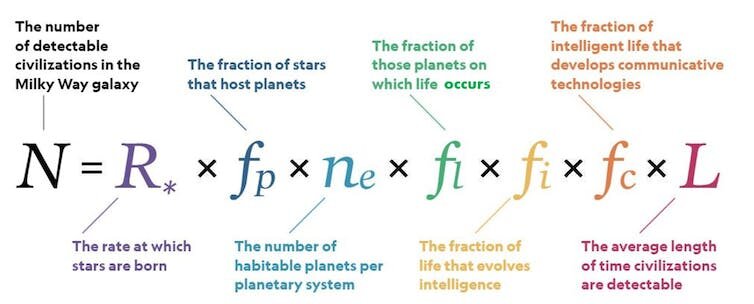
In November 1961, astronomer Frank Drake convened a small scientific meeting at the Green Bank Observatory in West Virginia. To frame discussion about the search for extraterrestrial intelligence, Drake introduced what would later become known as the Drake Equation.
Rather than a definitive calculation, the equation was a framework — a way to break down an unknowable question into measurable components:
the rate of star formation, the fraction of stars with planets, the likelihood of life, intelligence, technology, and communicative longevity.
The Drake Equation did not answer the question of extraterrestrial life — but it legitimised asking it scientifically.
Crucially, it highlighted a growing tension:
even optimistic estimates suggested many civilizations should exist — and yet we detected none.
⸻
1967 — Pulsars and the First False Alarm
In 1967, graduate student Jocelyn Bell Burnell detected a strange, highly regular radio signal while analysing data from a new radio telescope. The signal was so precise that it was briefly nicknamed “LGM-1” — Little Green Men.
The source was later identified as the first known pulsar: a rapidly rotating neutron star emitting beams of radio waves.
This moment is important for two reasons:
• It demonstrated that nature itself can produce signals that appear artificial
• It reinforced the need for caution when interpreting radio detections
Pulsars expanded our understanding of extreme astrophysical phenomena — while simultaneously sharpening the challenge of distinguishing natural noise from intentional signal.
⸻
1977 — The Voyager Golden Records
In 1977, NASA launched Voyager 1 and Voyager 2, each carrying a Golden Record — a curated message intended for any extraterrestrial intelligence that might one day encounter the spacecraft.
The records contained:
• Sounds of Earth
• Music from multiple cultures
• Greetings in dozens of languages
• Images depicting life, science, and humanity
The Golden Records were never expected to succeed as communication devices. Instead, they represented something deeper:
a recognition that humanity had become aware of both its technological reach and the vastness of the silence beyond it.
That same year, the Fermi Paradox entered the scientific literature, sharpening the contrast between our willingness to speak — and the absence of any reply.
⸻
1977 — The Fermi Paradox Goes Mainstream
In March 1977, the first published scientific paper to reference the Fermi Paradox appeared in the Journal of the British Interplanetary Society (JBIS), helping to bring the idea from private conversation and informal discussion into the peer-reviewed literature. This marked a transition from an anecdotal puzzle to a recognised topic of scientific inquiry.
21st Century — Breakthrough Listen
In 2015, the Breakthrough Listen project was launched — the most comprehensive search for extraterrestrial intelligence ever undertaken.
Using some of the world’s most powerful radio and optical telescopes, the initiative dramatically expanded:
• The number of stars surveyed
• The range of frequencies examined
• The volume of data analysed
Despite unprecedented sensitivity and scale, no confirmed extraterrestrial signals have been detected.
The silence persists.
⸻
Why These Moments Matter
From the systematic mapping of the stars to the first deep-sky surveys, from the advent of radio technology to early attempts to listen to the cosmos, and finally to the formal recognition of the Fermi Paradox in scientific literature — each of these milestones contributed to the conditions that make the “Great Silence” one of the most enduring questions in science.
They tell a story of:
- Growing observational precision
- Expansion of our cosmic horizons
- A transition from describing the universe to questioning our place within it
⸻
Now imagine what happens, When The Silence Ends